2026 tax brackets: a guide for small businesses and freelancers
Learn the 2026 federal tax brackets and how they apply to your small business.

Written by Kari Brummond—Content Writer, Accountant, IRS Enrolled Agent. Read Kari's full bio
Written by Kari Brummond—Content Writer, Accountant, IRS Enrolled Agent. Read Kari's full bio
Published Wednesday 10 June 2026
Table of contents
Key takeaways
- The 2026 federal income tax rates range from 10% to 37%, and the standard deduction increased to $16,100 for single filers, $24,150 for head of household, and $32,200 for married filing jointly.
- Pass-through businesses (sole proprietorships, partnerships, and S-corps) report profits on the owner's personal return, while C-corps pay a flat 21% corporate tax rate at the entity level.
- The One Big Beautiful Bill Act made the QBI deduction permanent (increasing it to 23%) and made 100% bonus depreciation permanent, giving small businesses more predictable tax planning for future years.
- Your effective tax rate depends on your business structure, deductions, and credits, so choosing the right setup and maximizing deductions can significantly lower your tax bill.
Federal income tax brackets
The 2026 federal income tax rates range from 10% to 37%, applied progressively based on your taxable income and filing status. These brackets apply to everyone who files a U.S. individual income tax return, but small business owners and investors also need to understand how self-employment tax and capital gains tax affect their total liability.
The IRS uses a progressive income tax system, which means rates increase as your income gets higher. The agency adjusts income tax brackets annually based on inflation, and new tax legislation often adjusts brackets and rates as well.
Here are the 2026 tax brackets for single filers:
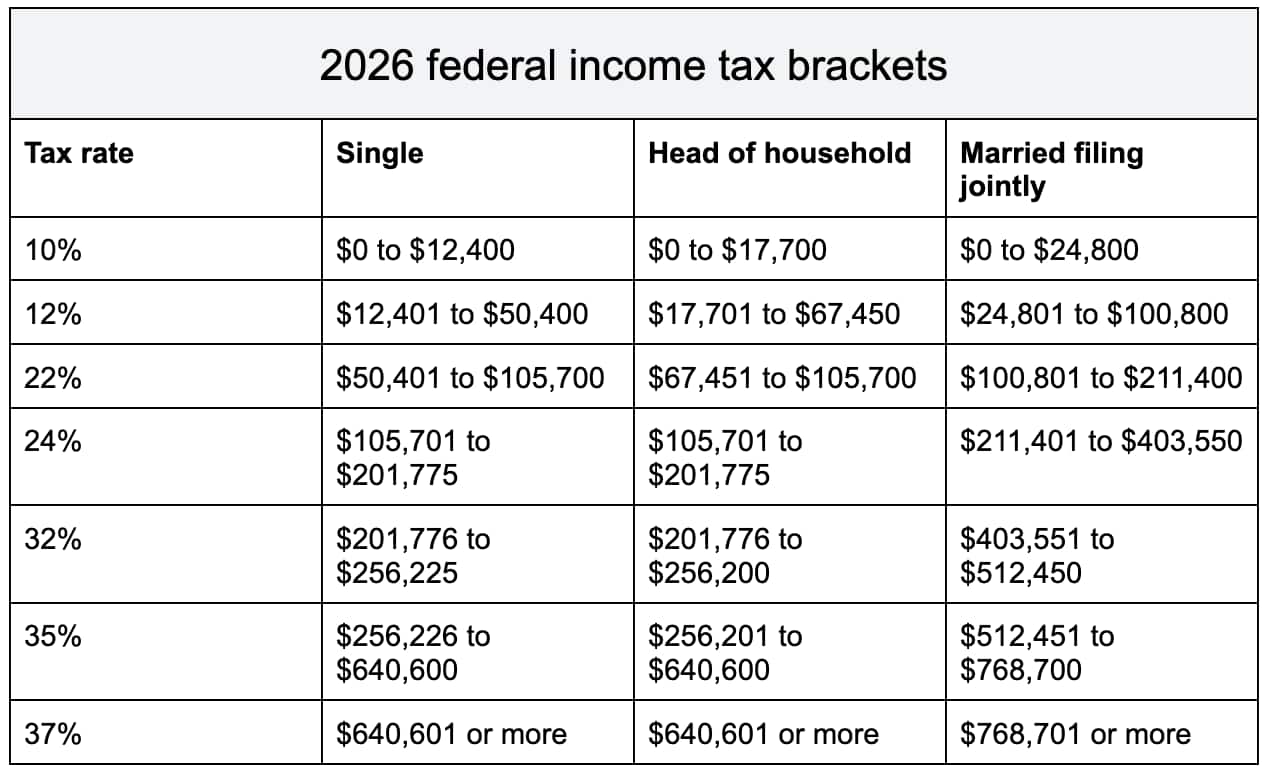
- 10%: up to $12,400
- 12%: $12,401 to $50,400
- 22%: $50,401 to $105,700
- 24%: $105,701 to $201,775
- 32%: $201,776 to $256,225
- 35%: $256,226 to $640,600
- 37%: over $640,600
Here are the 2026 tax brackets for married filing jointly:
- 10%: up to $24,800
- 12%: $24,801 to $100,800
- 22%: $100,801 to $211,400
- 24%: $211,401 to $403,550
- 32%: $403,551 to $512,450
- 35%: $512,451 to $768,700
- 37%: over $768,700
Here are the 2026 tax brackets for head of household filers:
- 10%: up to $17,700
- 12%: $17,701 to $67,450
- 22%: $67,451 to $105,700
- 24%: $105,701 to $201,775
- 32%: $201,776 to $256,200
- 35%: $256,201 to $640,600
- 37%: over $640,600
These rates apply to your taxable income, which is your income after deductions. If you have long-term capital gains, they may be taxed at a lower rate (see below).
Learn more about 2026 tax brackets and tax changes from the IRS.
How federal tax brackets work
Federal tax brackets use a progressive system, which means only the income within each bracket is taxed at that bracket's rate. You don't pay one flat rate on all your income. Instead, different portions of your income are taxed at different rates.
There are two important tax rate concepts to understand as a small business owner:
- Marginal tax rate: this is the rate applied to your last dollar of taxable income. It's the highest bracket your income reaches.
- Effective tax rate: this is the actual percentage of your total income you pay in taxes after all brackets are applied. It's always lower than your marginal rate because your lower income is taxed at lower rates first.
Here's a quick example. Say you're a single filer with $80,000 in taxable income in 2026. Your tax would be calculated like this:
- The first $12,400 is taxed at 10% = $1,240
- The next $38,000 (from $12,401 to $50,400) is taxed at 12% = $4,560
- The remaining $29,600 (from $50,401 to $80,000) is taxed at 22% = $6,512
Your total federal income tax would be $12,312. That's a marginal rate of 22% but an effective rate of about 15.4%. Understanding this difference helps you plan more accurately and avoid overestimating your tax bill.
Capital gains tax brackets
Short-term capital gains are taxed at your ordinary income tax rate and apply to assets sold within one year of purchase. Long-term capital gains come from assets held for more than a year and are taxed at lower rates.
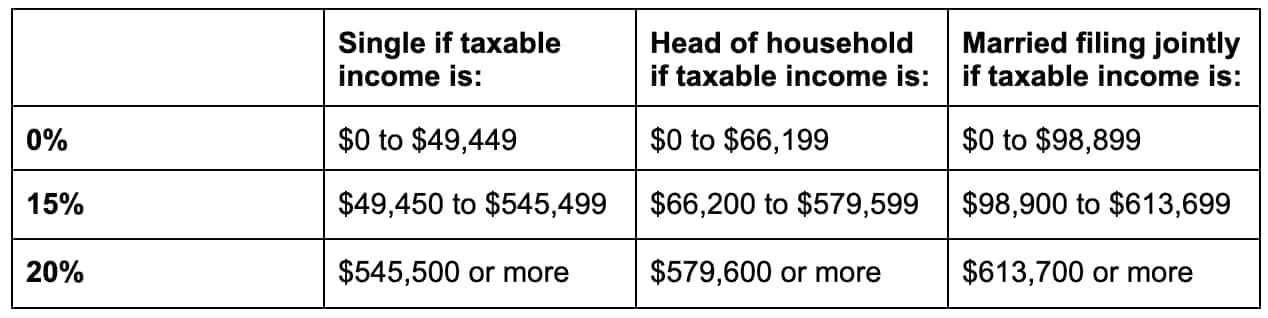
The rate depends on your taxable income. Here are the 2026 long-term capital gains tax brackets for single filers:
- 0%: taxable income up to $49,450
- 15%: taxable income from $49,451 to $545,500
- 20%: taxable income over $545,500
Here are the 2026 long-term capital gains tax brackets for married filing jointly:
- 0%: taxable income up to $98,900
- 15%: taxable income from $98,901 to $613,700
- 20%: taxable income over $613,700
Capital gains tax brackets work differently from income tax brackets. With income tax, your taxable income is taxed progressively, so most taxpayers pay multiple marginal rates. Long-term capital gains use three rates (0%, 15%, or 20%) based on your total taxable income.
Capital gains are stacked on top of your other income, and different portions of the gain may fall into different capital gains brackets. For example, if you're a single filer and your taxable income (including long-term capital gains) is $48,000, your long-term capital gains would likely fall in the 0% bracket. If your taxable income is $100,000, your long-term capital gains would generally fall in the 15% bracket, though very large gains could push a portion into the 20% bracket.
Both the 2026 federal income tax brackets and capital gains rates apply to your taxable income, which is your income after deductions.
IRS Topic 409 explains more about capital gains and losses.
What is the standard deduction amount?
The standard deduction is the amount you subtract from your income before calculating your tax. Every taxpayer who files a return gets to claim either the standard deduction or itemized deductions.
The 2026 standard deduction amounts, based on filing status, are:
- Single: $16,100
- Head of household: $24,150
- Married filing jointly: $32,200
You get a slightly higher standard deduction if you're over age 65 or blind, and a double increase if both apply to you.
Alternatively, you may itemize deductions. This means adding up deductible personal expenses and deducting that total from your income instead of the standard deduction. Only about 10% of taxpayers itemize, and typically only if their itemized deductions exceed the standard amount.
Itemized deductions include mortgage interest, state and local taxes (SALT), and medical expenses. These deductions are subject to limits or thresholds. For example, you can only itemize medical expenses above a certain threshold, and the SALT deduction is capped at $40,400 for 2026 (for joint filers; the cap is $20,200 for single filers).
Taxpayers can also claim certain above-the-line deductions on top of their standard or itemized deduction. These include certain retirement account contributions and student loan interest (subject to income limits). Above-the-line deductions reduce your adjusted gross income before you apply the standard or itemized deduction.
How federal tax brackets work for different types of small businesses
Your business structure determines how your profits are taxed and which brackets apply. Pass-through businesses (sole proprietorships, partnerships, and S-corps) report profits on the owner's personal tax return, while C-corps pay tax at the entity level.
Here's a breakdown of how federal tax brackets affect you based on your business structure.
Sole proprietorships and partnerships
If you're a sole proprietor, you report your profits directly on your individual income tax return using Schedule C. Partnerships file a partnership return (Form 1065) and then issue a Schedule K-1 showing each partner's share of profits, losses, and deductions.
Here's what happens on the owner's individual tax return in both cases:
- Self-employment tax generally applies to business profits at a rate of 15.3%.
- Business profit is combined with other income to calculate total income.
- Above-the-line deductions (including 50% of self-employment tax) reduce your adjusted gross income. Then the standard or itemized deduction reduces your taxable income.
- Income tax is calculated based on the total taxable income and the applicable bracket for the year.
- Tax credits reduce your tax liability. These include business credits, such as the qualified business income (QBI) deduction, and personal credits like the child tax credit.
Self-employment tax covers both the employer and employee portions of Social Security and Medicare that are typically split in a traditional employment arrangement.
S-corporations
An S-corp can help you save on self-employment tax compared to operating as a sole proprietorship. If you're weighing your options, comparing S-corp and LLC structures can help you decide.
The S-corp files its own tax return and issues Schedule K-1s reporting each owner's share of profits. The S-corp reports the following as expenses on its business tax return:
- Wages paid to owners.
- Employer payroll taxes based on those wages.
It also issues W-2s to any owner-shareholders who work in the company.
To report your S-corp income, take these steps:
- Add the income from the Schedule K-1 and the W-2 to income from all other sources on your individual income tax return.
- Subtract the standard or itemized deduction, as well as any other deductions, to determine your taxable income.
- Calculate your tax liability based on the taxable income and the current federal tax brackets.
- Use individual tax credits, if available, to reduce your tax liability.
S-corp owners don't pay self-employment tax on their share of business profits. Instead, the business withholds Social Security and Medicare tax from the owner-employee's pay, and then the business makes a matching payment.
C-corporations
C-corps file a corporate income tax return and pay tax at the entity level on their profits. The 2026 corporate tax rate is a flat 21%. For example, if a corporation has $100,000 in profits, it will owe $21,000 in corporate income tax. However, there are all kinds of business deductions and tax credits to help lower the effective rate.
Corporations claim wages paid to owners and shareholders as business expenses and issue W-2s to those individuals. If a C-corp issues dividends to owners or shareholders, it can't claim a deduction for the dividends, and it reports the payments using 1099-DIV forms.
Owners and shareholders who receive W-2s or 1099-DIVs report those as income on their personal tax returns and pay tax according to their other income, deductions, and credits.
If you file taxes for an LLC, the process varies depending on whether you're taxed as a sole prop, partnership, or corporation. Understanding what an LLC is and how it's classified can help you determine which rules apply.
The IRS classifies business structures for tax purposes based on entity type, which determines which forms you file and how your income is taxed.
How much do small businesses pay in taxes?
Most small businesses pay an effective federal tax rate between 20% and 30%, depending on their business structure, income level, and deductions. Your actual rate will vary based on how your business is organized and which credits and deductions you claim.
Federal income tax is just one part of the picture. Small businesses may also owe several other types of taxes:
- Self-employment tax: sole proprietors and partners pay 15.3% on net business income to cover Social Security and Medicare.
- Payroll taxes: if you have employees, you'll owe the employer share of Social Security (6.2% up to $184,500 in 2026), Medicare (1.45%), and federal unemployment tax (FUTA).
- State income tax: rates vary widely by state. Some states, like Texas and Florida, have no state income tax, while others, like California and New York, have rates above 10%.
- Sales tax: if you sell taxable goods or services, you may need to collect and remit state and local sales tax.
Because so many factors affect your total tax bill, it's a good idea to work with a tax professional who understands your specific situation. They can help you identify all the taxes you owe and find opportunities to reduce your overall liability.
What has changed for small businesses this year
The One Big Beautiful Bill Act made several tax provisions permanent for 2026, including the QBI deduction (increased to 23%) and 100% bonus depreciation. Both had been scheduled to expire in 2025 but are now a permanent part of the tax code.
These changes come at a time when many small businesses are feeling the squeeze. According to Xero Small Business Insights, US small business sales growth averaged just 2.4% year-over-year in 2025, roughly half the long-term average of 5.5%, making deductions and credits especially important for managing tax liability.
Here are some of the main changes that may affect your effective small business tax rate in 2026:
- QBI deduction made permanent and increased: the pass-through business income deduction increased from 20% to 23% of qualified business income, subject to certain rules and limitations.
- 100% bonus depreciation made permanent: allows businesses to deduct 100% of qualifying capital assets in the year they're placed in service, rather than depreciating them over time.
- Increased limits for Section 179 deductions: the maximum deduction increased to $2.56 million, with a raised phase-out threshold of $4.09 million.
- Research and development (R&D) expenses: can now be deducted in the year expenses are incurred, rather than amortized over several years. Qualifying businesses can also amend previously filed returns to claim retroactive benefits.
- Standard mileage rate: increased to 72.5 cents per mile, up from 70 cents per mile in 2025.
- SALT deduction cap: increased to $40,400 for 2026 (for married filing jointly; $20,200 for single filers), up from $10,000 in prior years.
The QBI deduction and bonus depreciation originally started in 2018 under the Tax Cuts and Jobs Act and were scheduled to phase out. Making them permanent gives small businesses more certainty for long-term tax planning.
How depreciation and deductions lower your tax bill
Depreciation and deductions reduce your taxable income, which directly lowers the amount of tax you owe. Understanding the different options helps you time your purchases and maximize your savings.
There are three main ways to deduct the cost of business assets:
- Bonus depreciation: lets you deduct 100% of the cost of qualifying new or used assets in the year you put them into service. This is ideal for large purchases like equipment, vehicles, or machinery.
- Section 179 deduction: also allows you to deduct the full cost of qualifying assets in the first year, up to $2.56 million for 2026. The phase-out begins when total asset purchases exceed $4.09 million. Unlike bonus depreciation, Section 179 can't create a net loss.
- Standard depreciation: spreads the cost of an asset over its useful life (for example, five years for computers or seven years for office furniture). This is often used when the other two options don't apply or when you want to spread deductions across multiple years.
Here's a practical example. Say you buy $50,000 in equipment for your business in 2026. With bonus depreciation, you can deduct the entire $50,000 in year one. That reduces your taxable income by $50,000. If you're in the 24% bracket, that's a potential tax savings of $12,000 in the first year alone.
Without bonus depreciation, you'd spread that deduction over five to seven years using standard depreciation, which means smaller deductions each year and a higher tax bill upfront.
R&D expenses now follow a similar pattern. If you invest in research and development, you can deduct those costs in the year they're incurred rather than spreading them out. This is especially helpful for small businesses investing in new products or processes.
Choosing between these options depends on your income level, how much you've invested in assets, and your long-term tax strategy. A tax professional can help you figure out which combination saves you the most.
How to estimate your tax bill
If your earnings are similar to last year's, your prior year tax liability is a useful starting point for estimating this year's bill. This approach works well for determining your quarterly estimated payments. Just keep in mind that changes to tax brackets, the tax code, or your personal situation can shift your current year liability.
If you own a sole proprietorship or partnership, here's how you can estimate your tax liability:
- Multiply your anticipated profits by 15.3% (the 2026 self-employment tax rate).
- Add up all of your income and subtract the 2026 standard deduction amount.
- Find the 2026 tax brackets that apply to your situation and calculate your tax.
Keep in mind this doesn't include tax credits or additional deductions. As a general rule, many small business owners set aside 25% to 30% of their net income for federal taxes to avoid surprises at filing time.
You could use an income tax calculator to help you. It's also a good idea to ask an accountant to help figure out how to calculate estimated taxes in 2026. They might also lower your taxes by helping with your small business tax preparation and planning.
How to lower your small business tax rate
You can lower your effective tax rate by reducing your taxable income through deductions, credits, and smart planning. The key is to take advantage of every legitimate strategy available to your business.
Here are some of the most effective ways to reduce your small business taxes:
- Maximize your deductions: track every deductible business expense throughout the year, including office supplies, software, travel, and home office costs. Using accounting software like Xero can help you categorize expenses automatically so you don't miss anything at tax time.
- Contribute to retirement accounts: contributions to a SEP-IRA, SIMPLE IRA, or solo 401(k) reduce your taxable income. For 2026, sole proprietors can contribute up to 25% of net self-employment income to a SEP-IRA, up to the annual limit.
- Claim the QBI deduction: if you're a pass-through business owner (sole prop, partnership, or S-corp), you may be eligible for a 23% deduction on qualified business income. This deduction was increased from 20% and made permanent under the One Big Beautiful Bill Act.
- Consider your business structure: the right entity structure can save you thousands in taxes. For example, switching from a sole proprietorship to an S-corp may reduce self-employment tax if your business earns enough to justify a reasonable salary split.
- Time your income and expenses: if you use cash-basis accounting, you can sometimes shift income or expenses between tax years to stay in a lower bracket. For example, you might delay invoicing in December or prepay deductible expenses before year-end.
- Take advantage of depreciation: use bonus depreciation or Section 179 to deduct the full cost of qualifying assets in the year you buy them, rather than spreading the deduction over several years.
Every business is different, so it's worth consulting a tax professional to build a strategy tailored to your situation. Even small adjustments to your approach can add up to meaningful savings over time.
Make tax time easy with Xero
Staying on top of your finances throughout the year makes tax season much less stressful. Xero's cloud accounting software helps you track income and expenses in real time, so you always have accurate numbers ready when it's time to file.
With Xero, you can automate bank reconciliation, categorize transactions, and pull financial reports whenever you need them. That means less time scrambling for records and more time focusing on what matters: maximizing your deductions and credits. Try it for yourself and get one month free.
FAQs on 2026 tax brackets for small businesses
Here are some frequently asked questions about 2026 tax brackets and how they apply to small businesses.
What tax bracket will I be in?
Your tax bracket depends on your taxable income and filing status. Most people fall into multiple brackets because the system is progressive. For example, if you file as head of household with $100,000 in taxable income, the first $17,700 is taxed at 10%, the next $49,750 at 12%, and the remaining $32,550 at 22%.
What is the difference between marginal and effective tax rate?
Your marginal tax rate is the rate applied to your last dollar of income, while your effective tax rate is the overall percentage of your total income you actually pay in taxes. Because of the progressive bracket system, your effective rate is always lower than your marginal rate.
Do tax brackets change this year?
Yes, tax brackets change annually based on inflation adjustments. The One Big Beautiful Bill Act, passed in 2025, also increased 2026 tax brackets beyond their usual inflationary adjustment and made several provisions like the QBI deduction and bonus depreciation permanent.
What is the self-employment tax rate?
The self-employment tax rate in 2026 is 15.3%. That includes 12.4% for Social Security taxes and 2.9% for Medicare taxes. This rate applies to net earnings from self-employment for sole proprietors and partners.
How much should I set aside for small business taxes?
A common guideline is to set aside 25% to 30% of your net business income for federal taxes. This estimate covers both income tax and self-employment tax. Your actual rate may be higher or lower depending on your deductions, credits, and filing status.
What is the corporate tax rate in 2026?
The federal corporate tax rate for C-corporations is a flat 21% in 2026. This rate applies to the corporation's taxable income at the entity level. Owners and shareholders pay additional tax on dividends or wages they receive from the corporation.
Are there different tax brackets within each state?
Yes, most states have their own income tax brackets with different rates and thresholds. Some states, like Texas, Florida, and Wyoming, have no state income tax at all. Even if your business doesn't owe federal tax at the entity level, it may still owe state-level taxes such as franchise tax or gross receipts tax.
Where can I find official IRS numbers?
The IRS federal income tax rates page is the best place to find up-to-date numbers on tax brackets, small business tax rates, and new tax laws. You can also ask an experienced tax preparer for help with your specific situation.
Disclaimer
Xero does not provide accounting, tax, business or legal advice. This guide has been provided for information purposes only. You should consult your own professional advisors for advice directly relating to your business or before taking action in relation to any of the content provided.
Get one month free
Sign up to any Xero plan, and we will give you the first month free.